
The Missing Generation and Where I Found Them
Two lives reduced to a single line in a register. Two graves lost somewhere in the Mayo clay. But I finally know where my great-great-grandparents are buried.

The email from Jim O’Connor at Mayo County Council arrived on a Tuesday in December. I’d been waiting for it, checking my inbox more often than I’d like to admit, hoping he’d found something in the Bushfield Cemetery registers. Hoping for names, dates, a location. Anything that would help me find my great-great-grandparents.
What I got instead was confirmation of something I’d suspected but hadn’t wanted to believe: they’re there, Catherine and Michael Dunleavy, buried somewhere in Bushfield Cemetery near Charlestown. But their graves have no markers. No numbers in the register. No way to find them.
Catherine Dunleavy, age 75, died March 9, 1928. Widow. Michael Dunleavy, age 86, died May 20, 1921. Married.
Two lives reduced to a single line in a register. Two graves lost somewhere in the Mayo clay.
The Graves We Know
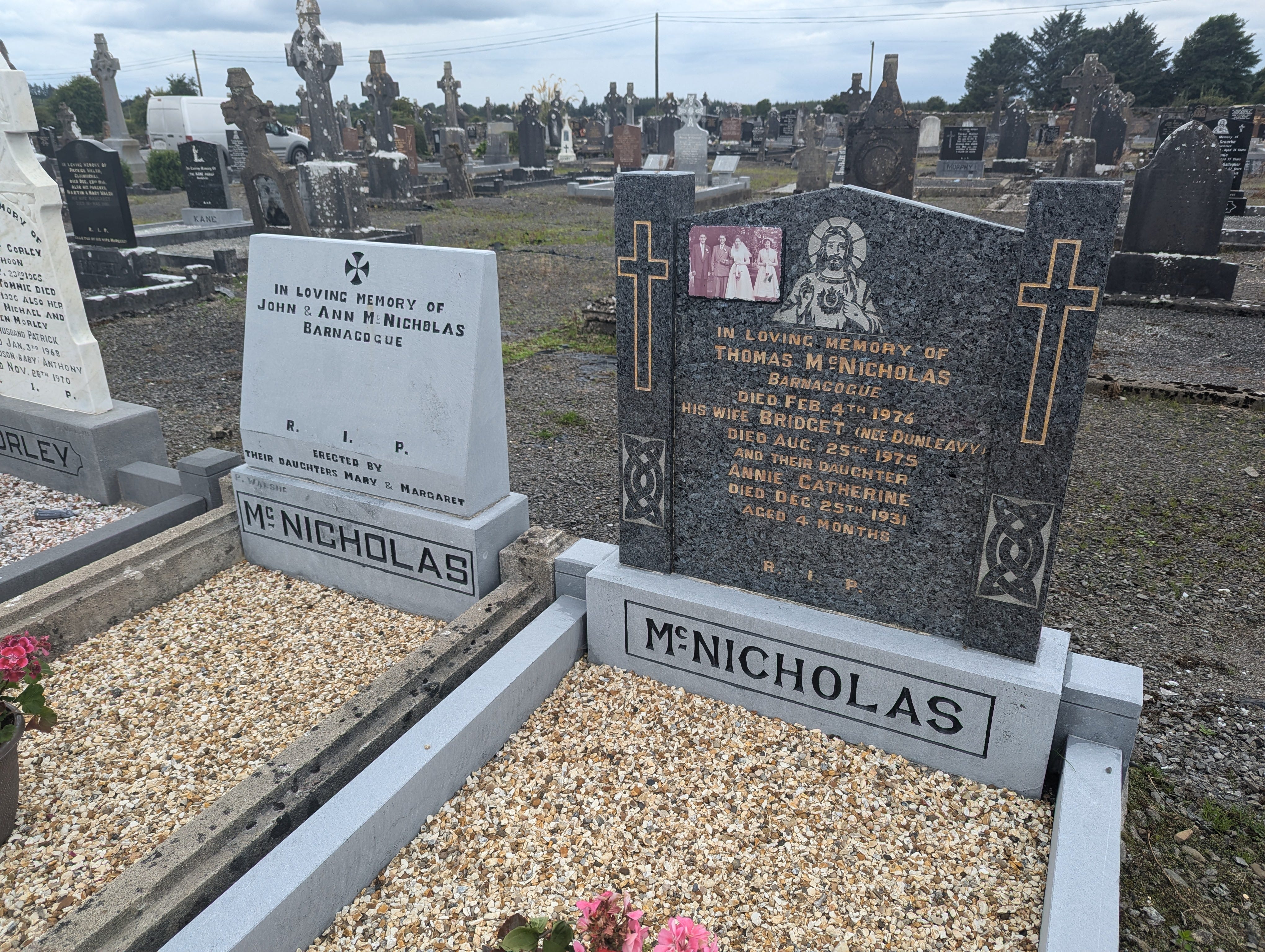
My family friend John Lenehan and I have just finished restoring the grave of my great-grandparents, Bridget McNicholas (née Dunleavy) and Thomas McNicholas. They’re Catherine and Michael’s daughter and son-in-law, and their grave in Bushfield at least has a marker, a location, something physical to tend and honour.
We scraped away years of lichen and weather. We re-lettered the names. We planted flowers. It felt good to do something tangible, to make their resting place visible again, to say: you mattered, you’re remembered, we’re still here.
But even as we worked, I kept thinking about Catherine and Michael. About the generation that came before. About how they’re somewhere in this same cemetery, possibly just yards away, and I can’t find them
When Records End
This is the reality of Irish genealogy once you push back past a certain point. The trail doesn’t so much end as it dissolves, scattering into fragmentary records, oral history, and educated guesses.
Civil registration of deaths in Ireland only began in 1864. Before that, you’re reliant on church records, and those vary wildly in completeness and survival. Bushfield Cemetery has registers, thank God, but they’re barebones. A name, an age, a date, a status. Widow. Married. Sometimes not even that.
And graves? Many of the older graves in rural Irish cemeteries were never marked with stone. A wooden cross, perhaps, which rotted away decades ago. Or nothing at all, just the knowledge held in living memory: “That’s where the Dunleavys are buried, there by the hawthorn.” But memory dies with the last person who held it, and then there’s only unmarked ground.
Jim O’Connor’s email was kind, professional, apologetic in the way archivists are when they know you were hoping for more. He’d found the entries. He’d included images of the register pages, the handwriting faded but legible, the ink brown with age. But there were no grave numbers. Nothing to help me locate them in the cemetery itself.
“I hope some of this is of assistance to you,” he wrote.
It was. But it also confirmed what I’d feared: that this is as close as I’ll ever get.
The Family Plot That Might Be
There’s a theory, based on family memory and the logic of how these things were usually done. Catherine and Michael’s son Brian is buried in Bushfield with his wife Annie. Their grave does have a marker. And in the Irish tradition of family plots, of generations buried together, it makes sense that Catherine and Michael would be there too.
Somewhere near Brian and Annie. Possibly in the same plot. Unmarked, unnumbered, but there.
I’ve stood at Brian and Annie’s grave and looked at the ground around it, trying to see what can’t be seen. Trying to imagine where the previous generation lies. It’s an exercise in hopeful speculation, and I know that. But it’s all I have.
The thing is, this would have been normal. Expected, even. In rural Mayo in the 1920s, not everyone got a headstone. Stones cost money that many families didn’t have, especially in the lean years after the War of Independence and during the Civil War. Some families intended to add stones later and never got around to it. Some thought the grave’s location within a family plot was marker enough. Some simply had other priorities: feeding the living took precedence over memorialising the dead.


What Gets Lost
I think about what it means to lose a generation like this. Not metaphorically, but literally. To know they existed, to have their names and dates, to know approximately where they’re buried, but to be unable to stand at the specific spot and say: here. This is where you are.
Catherine lived 75 years. She survived the Famine generation, raised children in a small townland in Mayo, became a widow, and died the year after Ireland became a Free State. She lived through more history than I can fully comprehend. And she’s somewhere in Bushfield Cemetery with no marker to show for any of it.
Michael lived even longer, 86 years spanning from the 1830s to 1921. He would have remembered the Famine, remembered Parnell, remembered the Land Wars. He married, raised a family in Shammer, and died just as Ireland was tearing itself apart in revolution. And he’s unmarked too.
Their daughter Bridget, my great-grandmother, at least has a stone now. Clean, legible, maintained. But her parents are lost to the ground.
This is the missing generation problem that so many of us face when we dig into Irish family history. You get back two or three generations with relative ease, following civil records and church registers, finding graves that are still marked and identifiable. And then you hit a wall. Not because the people didn’t exist, but because the records thin out, the graves go unmarked, and the living memory dies.
The Archivist’s Gift
I’m grateful to Jim O’Connor. I mean that sincerely. He didn’t have to spend his time searching through old registers for someone else’s ancestors. He didn’t have to scan the pages and write a careful email explaining what he’d found. But he did, and now I know something I didn’t know before.
I know Catherine died in 1928, not 1927 or 1929. I know she was 75, which means she was born around 1853. I know she was a widow when she died, which means Michael died first. I know his age, 86, which means he was born around 1835.
These are small facts, but they’re facts. They’re pieces of a life that might otherwise have disappeared completely. And I can add them to the family tree, update the records, ensure that someone knows, at least, that Catherine and Michael Dunleavy existed.
But I still can’t find their graves.
What We Owe the Dead
John and I restored Bridget and Thomas’s grave because it felt like the right thing to do. Because they deserved to be remembered properly. Because their names should be legible, their resting place should be tended, and future generations should be able to find them.
But what do we owe to the generation before them? To Catherine and Michael, who lie somewhere in the same cemetery but beyond our reach?
I’ve thought about this a lot. About whether it’s enough to know they’re there, even if I can’t pinpoint where. About whether maintaining Brian and Annie’s grave is a way of honouring Catherine and Michael too, since they’re likely nearby. About whether there’s any point in walking the cemetery rows, looking at the unmarked spaces between stones, hoping for some impossible sign.
I don’t have good answers. I only know that the missing generation haunts me in a way the found generations don’t.
When I visit Bushfield now, I go first to Bridget and Thomas. I check the stone, pull any weeds, stand there for a moment. And then I walk toward Brian and Annie’s grave, and I stand there too, looking at the ground around it.
“You’re here somewhere,” I say, to people who can’t hear me, to graves I can’t locate. “I know you’re here.”
It’s not enough. But it’s all I have.
The Mathematics of Memory
Here’s what I know for certain: within another generation or two, no one will remember that Catherine and Michael Dunleavy are buried unmarked in Bushfield Cemetery. The knowledge that they might be near Brian and Annie’s plot will fade, because I’ll be gone, and whoever comes after me won’t have the same obsessive need to find them.
Their names will persist in online family trees, in genealogy databases, in Jim O’Connor’s carefully kept registers. But the connection to the physical ground will be severed completely. They’ll become purely archival, data points without geography.
And in a way, that’s the fate of most of our ancestors. The lucky ones get stones that last. The rest dissolve back into the earth with nothing to mark their passage except, if we’re lucky, a line in a register somewhere. Age, status, date of death. Widow. Married.
The missing generation isn’t really missing. They’re exactly where they’ve always been, in the Mayo soil, part of the same earth their grandchildren played on and their great-great-grandchildren now visit. But they’re invisible to us, and that invisibility feels like a kind of abandonment, even though it isn’t our fault.
What Remains
I keep Jim O’Connor’s email. I’ve printed out the images of the register pages and filed them carefully with the other family documents. I’ve updated the family tree with the dates and ages he provided. I’ve marked in my notes that Catherine and Michael are buried in Bushfield Cemetery, possibly in or near the family plot with their son Brian.
This is what remains: data, speculation, and an archivist’s kindness.
And the next time I’m in Mayo, I’ll visit Bushfield again. I’ll tend Bridget and Thomas’s grave. I’ll walk to Brian and Annie’s stone. And I’ll stand there, looking at the unmarked ground, knowing that somewhere beneath my feet, within yards of where I’m standing, Catherine and Michael Dunleavy are resting.
I won’t find them. But I’ll know they’re there.
And maybe, in the end, knowing is its own kind of marker. Not stone, but memory. Not granite, but attention. Not permanence, but the refusal to let them disappear completely, even when the graves themselves have vanished.
The missing generation is still there, unmarked but not forgotten. And as long as someone remembers to look for them, as long as someone stands in that cemetery and says their names, they’re not entirely lost.
Have you searched for a missing generation in your own family? I'd love to hear your story in the comments.